
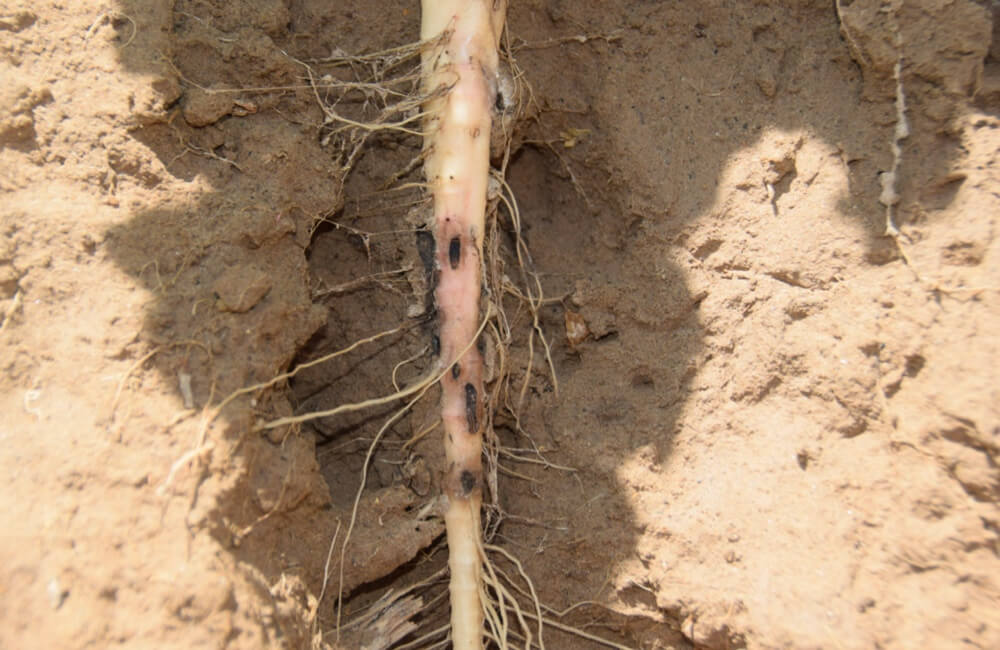
Sugarbeet root maggot has damaged several inches of this sugarbeet root. A monitoring system is essential to staying ahead of this kind of potential damage.
Monitoring Key for Post-Emergence Applications
It’s about that time. The crop is up, the weather is warm and the race is on to see who ultimately harvests the sugar – the grower or the maggot.
Sugarbeet root maggot is one of the most destructive pests growers face in any given year. Left untreated, or inadequately treated, larvae can devastate profits by lowering both tonnage and sucrose content.
Post-emergence control is the preferred management strategy to deal with sugarbeet root maggot, according to Erik Wenninger, Ph.D., Entomologist, University of Idaho, Kimberly Research and Extension Center.
“I believe that post-emergence application informed by fly monitoring is the most cost- effective approach because it avoids having to apply insecticides unnecessarily before pest densities are known,” Wenninger says.
Sorting Through the Uncertainty
Various post-emergence pesticides are available for sugarbeet root maggot control and can be used effectively depending on a grower’s strategy to address the pest and the potential severity of the infestation.
While it appears that chlorpyrifos will be available in 2025 for sugarbeet growers in some states, the uncertainty of future availability looms formidably. Forward looking growers are already evaluating their options should that scenario play out in upcoming seasons. Luckily there are options – even at post-emergence.
As growers consider post-emergence options, terbufos and phorate are two options available that target larvae, while various pyrethroid postemergence sprays can be used to knock down adult flies. AgLogic 15GG aldicarb, a granular insecticide/nematicide also targeting larvae, is another post-emergence option that has seen resurgence in recent years due to its efficacy.
For moderate to high levels of projected sugar beet root maggot, AgLogic 15GG is usually the preferred option – especially when root maggot populations are forecast in the moderate to high range.
“In years of trials, aldicarb (AgLogic 15GG) has been the most effective product to control sugar beet root maggot,” Wenninger says.
Water Solubility and Flexibility
AgLogic 15GG has advantage in post-emergence sugarbeet root maggot management due to its high water solubility which allows for more flexibility in timing of application, according to Wenninger.
“Other products such as terbufos and phorate are similar in that they can be applied post-emergence,” Wenninger says. “But they may need to be applied in ‘anticipation’ of the threshold being reached based on monitoring data and previous experience since these products will require more time to be taken up by the plant.”
Monitoring Program
Monitoring is key for post-emergence success. Amalgamated Sugar Company has ramped up sugarbeet root maggot fly monitoring across much of its purview over the past few years.
The program is straightforward and very effective. Sticky traps are deployed adjacent to sugarbeet fields – usually around April or the first of May – and monitored for adult flies. Results from the sticky traps are then used to predict impending maggot larvae populations in the soil that will feed on plant roots hampering plant development. Larval root feeding also inflicts wounds that can lead to increased root-rot disease, potentially resulting in severe stand loss.
“When those sticky traps for adult flies hit the action threshold, growers know they’re going to need to do something,” Wenninger says. “AgLogic 15GG at post- emergence works very well under this scenario due to its water solubility. That makes it especially effective under irrigated scenarios because we can add as much water as needed to initiate uptake into the plant as quickly as possible.”
Increasing Maggot Pressure
While it’s difficult to pinpoint what exact factors lead to heavy root maggot infestations from season to season, Wenninger says the pest seems to be an increasingly worrisome issue.
“In Idaho where root maggots are the most abundant, the monitoring program has identified about two-thirds of fields that were monitored had economic thresholds that justified treatment,” he says. “That’s been fairly consistent for the past four seasons or so. It’s changed over the years, but root maggots are a real threat worthy of monitoring every single year.”
Luckily sugarbeet growers have a head start on maggots due to the monitoring program. While the maggots might deem it an unfair advantage, growers still have the post-emerge tactics to win the race.
Originally Published in Sugar Producer Magazine’s June/July 2025 Issue