
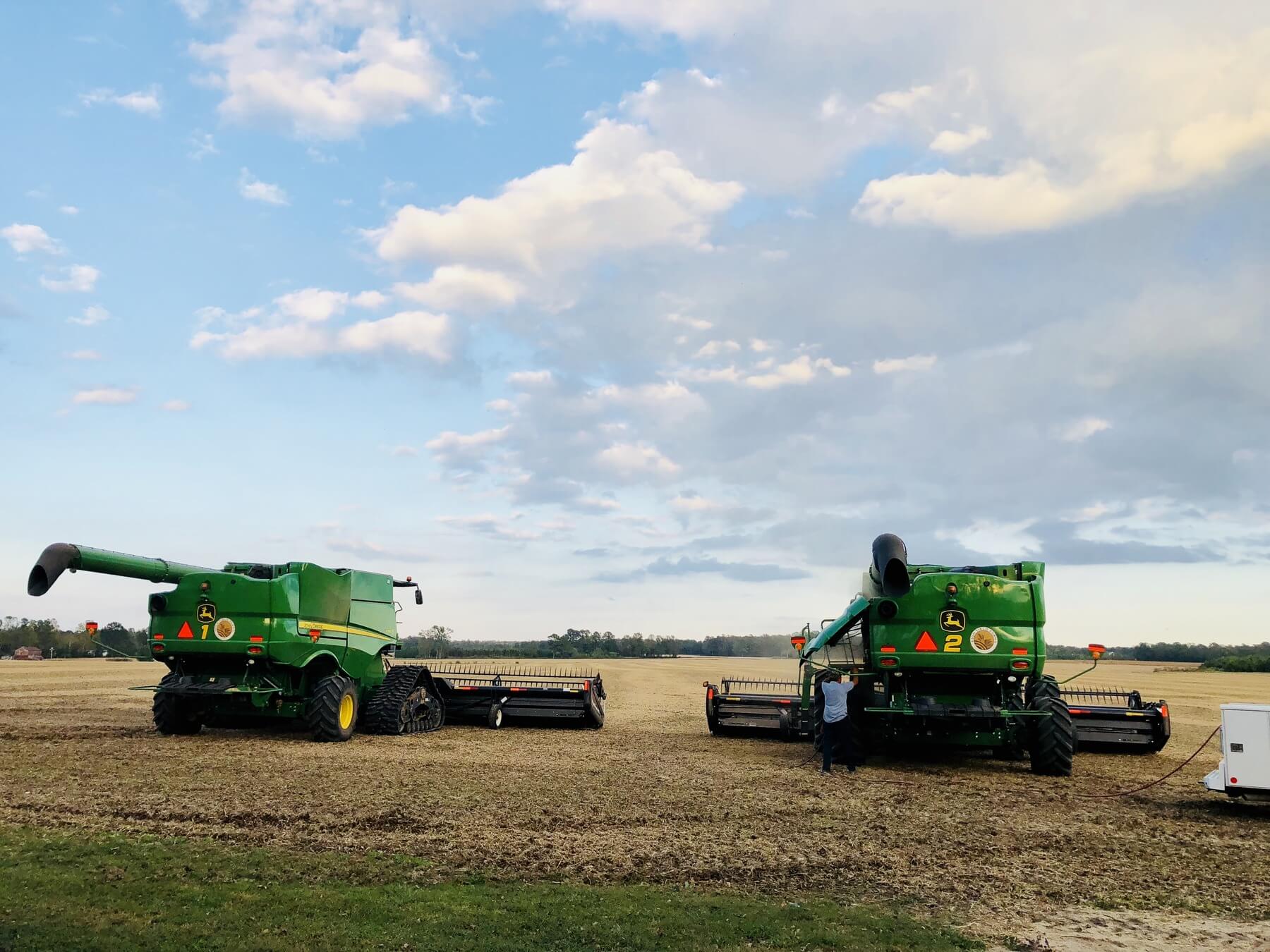
Soybean harvest at High Yield Farms. (Photo courtesy of Al Hill)
Extended version of article originally published in Southeast Farm Press’ February 4, 2026 Issue
Early Intervention Sets the Stage
It’s always easier to make a crop than rescue a crop. At least that’s the way Al Hill with High Yield Farms in Deep Run, NC sees it.
“Our biggest challenge before we even put a soybean seed in the ground is soybean cyst nematode,” he says. “You have to address that one up front or it will destroy you going forward. Yield is important, but the first step is just trying to get the plant to survive pressures such as nematodes.”
Hill has a diversified farming operation headquartered in Deep Run, NC that spans roughly 20 miles in all directions across four counties – Lenoir, Craven, Onslow and Duplin. In addition to dryland soybeans, he grows corn and grain crops using rotation, in part, to manage pests and soil health.
“I usually grow two years of soybeans and rotate with a year of corn,” he says. “I prefer soybeans because it’s not as risky as corn. The yields are more dependable. I can make 60 bushels of dryland beans pretty consistently, or maybe more. When it comes to corn, I can make 230 bushels of corn, or I might only make 100 bushels of corn. It just depends on so many factors.”
Continuous soybeans, however, is not an option Hill even considers. “We rotate with corn because it helps with nematodes and soil-borne and plant diseases,” he says.
History Matters
Cropping patterns that have existed in a particular field in years past can make a significant difference in what growers face in the here and now.
“Twenty-something years ago, it was common to have a three-year rotation with tobacco on a lot of this sandier nematode land,” Hill says. “But tobacco has faded away. It’s probably only ten percent of what it was 25 years ago in terms of acres.
“When tobacco was grown, it was fairly common to use Telone on a field of tobacco. Once tobacco was taken out of the mix, and Telone was no longer used under that crop, the nematodes started coming back.
“Over time, the nematode populations built up in the soil and became very problematic with soybeans in particular. So that’s why we bought the planter with hopper boxes and started using AgLogic to address the nematode issue that Telone once took care of in the tobacco rotation.”
Sampling Soybean Cyst Nematode
Battling soybean cyst nematode starts with testing the prior year. Hill regularly samples fields post-harvest to determine nematode populations that may pose a problem the following season. He pays special attention to specific areas in a field where yields lag behind expectations. With onboard yield monitors at harvest, he can identify those spots in real time and focus on precise sampling to identify nematode hot spots.
“Typically, by harvest, we’ve already pulled the nematode samples from the corn land and the early beans on the land we’ve been treating the last three years, he says.
“And then when we finish harvest, we look at individual maps of the fields and go, ‘hey, was this a problem here, or what happened’? And if it looks like it’s a nematode problem, we’ll add that to the group of fields that we’re testing. And we can tell from our nematode testing that the numbers are dramatically going down with the AgLogic treatment. So, it’s not just that we can see the plant health and measure the yields going up, but when we re-sample the problem fields that we’ve treated, the numbers are dramatically going down in terms of the nematode count.”
Early Season Focus
With 2,700 acres of soybeans to coordinate in his crop portfolio, Hill manages seed selection carefully, balancing maturity, available genetic traits and supplemental seed treatments to maximize early season vigor.
“We grow beans from a 3.9 maturity all the way to a 5.8,” he says. “And we try to plant varieties that are nematode resistant. Even so, resistant varieties and seed treatments are not enough to totally overcome the problem. That’s why we use other measures such as AgLogic.”
In The Box
Hill is adamant about getting soybeans off to a strong start. In addition to seed treatments and carefully selected varieties with nematode resistance, he ups the ante with AgLogic 15GG in the hopper box at planting applied at 6 lbs. per acre.
“It makes a huge difference,” he says. “I don’t skimp on the rate. Even if you’re planting a nematode resistant variety, there’s nothing better than giving it a boost with AgLogic at planting. I’m a firm believer because I’ve seen what it can do – not only in one season, but over multiple years of production. We’ve had spots in our fields that were struggling because of nematodes, and now they’re thriving because we’ve made substantial headway controlling them with AgLogic.”
State Registrations
It is important to note that growers should look carefully at all crop and state registrations of any pest control product. “For soybeans, in particular, note that AgLogic 15GG is only registered on soybeans in Georgia, North Carolina, South Carolina and Virginia at this time,” says Lee Hall, Vice President of Business Development at AgLogic Chemical LLC.
Earliness By All Measures
Most agricultural inputs are judged primarily on what they are intended to control, suppress or manage. Sometimes it’s the secondary benefits that are just as beneficial but perhaps more difficult to quantify in a research trial.
“Crop canopy is very important,” he says. “If I can get that soybean plant up, growing and shading the rows as fast as possible, I cut down on weed pressure. That’s one reason I go with 20-inch rows on soybeans. It’s convenient because I don’t have to switch out equipment when I move from corn, but I can cut back on my seed population in soybeans, pick a variety with good lateral development and shade the rows faster. Then my weed management program is supplemented indirectly and/or directly from my nematode management program. There are a lot of different angles to consider.”
Canopy, Canopy, Canopy
“So, on the corn, 20-inch rows canopy quicker and we don’t have morning glories and weed escapes because the corn canopy is very quick,” Hill says. “And on the soybeans, it’s the same way. There’s a little more row spacing on 20-inch soybeans than a 15-inch row, but if you plant a bushier soybean, you can take advantage of some lateral branching.”
Yield Rules
“I’m a big fan of AgLogic,” Hill says. “If you don’t treat a nematode situation with a good, effective product, it’s only going to get worse. Once you get nematodes, you’ve got them until you get rid of them. You are not going to wish them away.”